

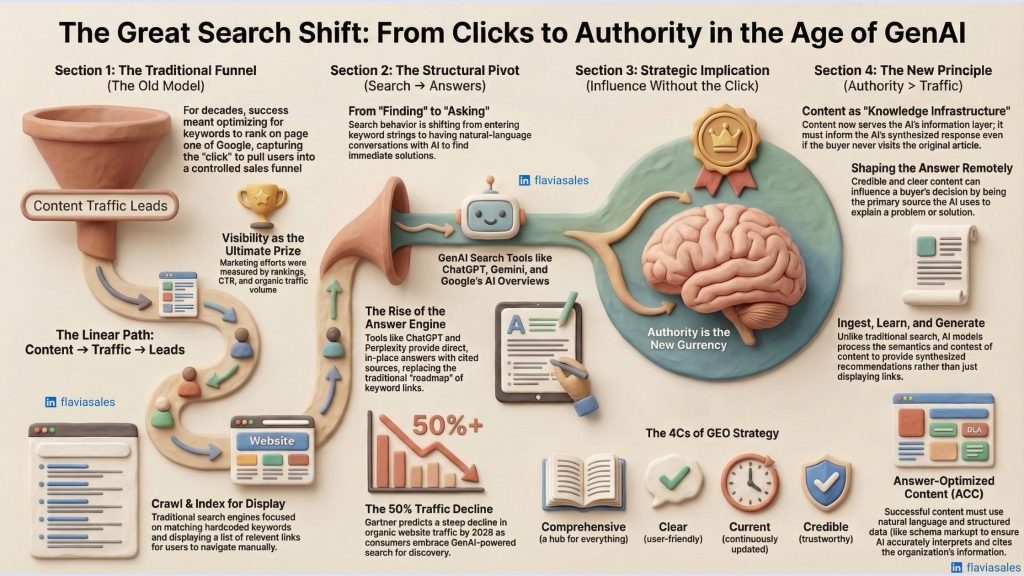
For more than a decade, content marketing followed a predictable logic.
Create useful content.
Optimize it for search engines.
Drive traffic to your website.
Convert some of that traffic into leads.
This simple equation shaped how marketing teams approached editorial planning, SEO strategy and digital growth. Most of us working in marketing assumed that the way buyers discovered information online revolved around search engines: a buyer typed a question, scanned a list of links, opened several pages and gradually built an understanding of the topic to influence or help their buying decision.
But the interface of knowledge discovery is changing.
Instead of navigating through links, users increasingly ask complete questions, and AI-powered search tools deliver direct answers rather than lists of links. Those answers are generated from multiple sources and usually include only a handful of references.
The shift may appear subtle, but its implications are significant. Buyers may still rely on the knowledge companies publish online, yet they may no longer need to visit those companies’ websites to access it.
In other words, content can influence decisions even when it does not generate the click.
For years, content marketing was largely built around visibility (rank on the first page of Google, capture attention, attract readers and move some of them into the sales funnel).
Generative AI now inserts itself directly into that journey. Instead of guiding users toward pages, it increasingly provides the answer itself.
Traffic won’t disappear entirely, but it may become less predictable and less central to discovery. This does not mean content loses its value. If anything, its influence may increase. It simply operates differently.
Instead of driving visitors directly to websites, content increasingly feeds the information layer that AI systems use to construct answers (GEO).
The companies whose content is seen as credible, clear and authoritative may end up shaping how problems and solutions are explained to buyers, even if those buyers never read the original article.
Authority becomes the new currency
If traffic becomes less reliable as a success metric, another dimension becomes more important: authority.
Generative systems rely on sources they interpret as trustworthy, well structured and informative.
Content that is vague, purely promotional or poorly organized is less likely to be used when an AI model assembles an answer.
In practice, this tends to favor content that demonstrates genuine expertise.
Clear explanations of complex topics.
Concrete examples and real use cases.
Context that helps buyers understand how a technology fits into actual business problems.
Ironically, this is also the type of content that many organizations struggled to produce when SEO tactics dominated editorial strategy. Too often the focus shifted toward producing large volumes of keyword optimized articles rather than building genuine knowledge resources.
The rise of generative search may reverse that incentive.
When the question becomes «Which sources does the AI trust enough to reference?», credibility starts to matter more than content volume.
What I am seeing in the market
I’m already seeing early signals of this shift in the tech ecosystem.
In conversations with founders building AI driven products, and during events such as 4YFN where hundreds of startups are experimenting with new AI applications, a common theme emerges. AI is not just changing software. It is changing how information flows through the market.
Many AI native companies are designing their products around conversational interfaces from the beginning. Users ask questions and expect direct explanations, not documentation buried across multiple pages.
At the same time, marketers are increasingly integrating generative tools into their daily workflows. Content ideation, research, drafting and analysis are all becoming partially automated.
The paradox is that while content production is becoming easier (apparently, anyone can generate text now), the strategic importance of high-quality knowledge is rising. The differentiator becomes insight, expertise, and clarity.
Rethinking content strategy for the AI era
This shift does not mean SEO disappears, nor that websites stop mattering. But it does challenge several assumptions that shaped content strategy.
Marketing teams may need to rethink their approach to it. This requires a different mindset. Instead of asking “How do we generate more traffic?”, the more relevant question may become:
“How do we become the source that shapes the answer?”
Some analysts have started referring to this shift as Generative Engine Optimization (GEO): optimizing content not just to rank in search results, but to become a trusted source in AI-generated answers.
What you need to do:
- First, content needs to answer real buyer questions, not just target keywords.
- Second, clarity and structure become critical. Well organized explanations are easier for both humans and AI systems to interpret and reuse.
- And third, companies may need to treat content less as a marketing asset and more as a knowledge infrastructure. A body of expertise that informs how the market understands a problem.
This does not eliminate the role of storytelling or brand positioning. It simply anchors those elements in substance.
The new goal of content
For years the success of content marketing was measured in clicks, rankings and traffic growth.
Those metrics will not disappear overnight. But they may gradually lose their dominance as generative interfaces reshape how buyers explore information.
The companies that adapt first will likely recognize a subtle but important shift.
The goal of content may no longer be only to attract the visit.
It may increasingly be to become the source that shapes the answer.
In a world where AI increasingly mediates discovery, visibility may no longer be the ultimate prize.
Authority will be.
About the author
Flávia Sales is a B2B marketing leader working with fast-growing technology companies. Her work focuses on building scalable marketing strategies that connect content, growth and revenue.
She also advocates for sustainability and more inclusive innovation in the tech industry.
LinkedIn: linkedin.com/in/flaviasales
Website: www.flaviasales.com
Deja una respuesta